
If you create or market mobile games, you already know that getting noticed in the app stores is one of the hardest challenges. Every week, thousands of new games are released on the Apple App Store and Google Play Store. Many of them are well-built, fun, and creative, yet only a small percentage reach their audience effectively. The main reason often comes down to one key element: App Store Optimisation (ASO).
ASO is the process that helps your game stand out, reach the right audience, and turn those views into downloads. But ASO is not just about adding a few keywords. It is a continuous, data-driven approach to how your game appears, performs, and communicates its value in the store.
In this detailed guide, we’ll break down what ASO is, how it works for gaming apps, and the specific steps you can take to improve visibility, downloads, and engagement.
What is App Store Optimisation (ASO)?
App Store Optimisation (ASO) is the process of improving your app’s visibility and conversion rate within app stores. Think of it as the equivalent of search engine optimisation (SEO) for websites, but focused entirely on how your app appears in mobile stores such as the App Store and Google Play.
The goal of ASO is simple: to make your game easier to find and more appealing to users who are searching for apps similar to yours. For mobile games, this is even more crucial because the competition is fierce and user attention spans are short.
ASO involves optimising several key elements:
- Keywords: The search terms users type to find apps.
- Title and subtitle: How you describe your game in a few words.
- Description: The detailed overview of your game’s features, story, and purpose.
- Visual assets: Icons, screenshots, and videos that represent your game.
- Ratings and reviews: The trust signals that influence users to click and download.
When these elements are well optimised, your game not only ranks higher in search results but also appears more trustworthy and interesting to potential players.

Why ASO is Essential for Mobile Games
Mobile game developers often focus heavily on paid advertising or influencer campaigns. While those strategies can drive installs, they are expensive and not sustainable on their own. ASO, on the other hand, drives organic downloads, which are free and more likely to result in long-term players.
Here’s why ASO should be at the heart of your marketing strategy:
1. Increases Visibility
ASO helps your game appear in search results when users look for similar experiences. If your keywords, visuals, and descriptions are optimised, you have a much higher chance of showing up on top of search results. For instance, if you’ve developed a “city-building strategy game,” appearing in searches for “city builder” or “strategy sim” can instantly increase your audience reach.
2. Drives Quality Installs
Paid ads can bring clicks, but often they attract casual users who uninstall after one session. ASO brings in users who are already interested in your type of game because they are actively searching for it. These users are far more likely to engage deeply and stay longer.
3. Improves Conversion Rate
Visibility alone doesn’t guarantee downloads. Players decide within seconds whether to tap “Install” or not. Optimised visuals, strong titles, and compelling descriptions all help convert those impressions into actual installs.
4. Reduces Dependence on Paid Advertising
A good ASO strategy builds consistent organic growth. This means you spend less on user acquisition while continuing to attract players naturally through search results and recommendations.
5. Supports Long-Term Growth
Unlike ads, which stop driving traffic once you stop paying, ASO builds momentum over time. The more downloads and positive reviews you get, the stronger your ranking becomes, creating a cycle of ongoing visibility.
How to Do Keyword Research for Games
Keyword research is the foundation of any ASO strategy. It helps you understand the exact words and phrases players are typing when they search for games like yours.
Step 1: Brainstorm Keywords Based on Your Game
Start by writing down terms that describe your game’s core features, genre, and mechanics. For example, if you’ve developed a role-playing game with real-time battles, your list might include “RPG,” “real-time combat,” “fantasy quest,” or “hero game.”
Include both broad terms (like “strategy game”) and specific terms (like “offline city builder”). Broad terms attract volume, while specific terms attract players who are more likely to download.
Step 2: Use ASO Tools for Insights
Tools such as AppTweak, App Radar, or Sensor Tower can show which keywords have high search volume and low competition. Look for keywords that strike a balance between popularity and attainability.
For example, “RPG” may have huge search volume but be very competitive. “Offline fantasy RPG” may have fewer searches but higher conversion potential.
Step 3: Study Competitors
Look at the top-ranking games in your category. Check their titles, descriptions, and reviews to see which keywords they use frequently. If you notice patterns, such as multiple successful games using “tower defense strategy,” that’s a strong signal to target similar terms.
Step 4: Include Long-Tail Keywords
Long-tail keywords are more specific search phrases. They usually have less competition but attract users with higher intent. For example, “RPG” is broad, but “turn-based RPG for iPhone” targets players who know what they want.
Step 5: Update Keywords Regularly
Trends in gaming change quickly. A term that worked six months ago might not bring traffic today. Review and refresh your keywords every few weeks to keep your app visible.
Writing an Effective App Description
Your app description plays a major role in turning visitors into downloads. It is not just about explaining what your game does; it is about convincing users that your game is worth their time.
1. Start Strong
The first few lines should instantly grab attention. Highlight what makes your game exciting and unique. For example:
“Build your empire, lead your heroes, and defend your city against real players worldwide in this fast-paced strategy game.”
2. Focus on Benefits, Not Just Features
Don’t just list features like “10 levels” or “HD graphics.” Explain what those features mean for the player. For example, “Master 10 unique worlds, each with its own challenges and rewards.”
3. Use Simple, Engaging Language
Avoid complex or overly technical terms. Write as if you’re talking to your players directly. Keep the tone conversational, clear, and positive.
4. Use Bullet Points for Readability
Break down your key features into easy-to-scan bullet points. Most users skim rather than read every word.
Example:
- Build and upgrade your base with dozens of unique structures
- Recruit heroes and form powerful alliances
- Compete in live PvP battles against real players
- Earn daily rewards and climb the global leaderboard
5. Include Social Proof
Mention awards, recognitions, or download milestones if applicable. Phrases like “Over 1 million players worldwide” can immediately boost trust.
6. Update Regularly
Keep your description current with each game update. Highlight new features or seasonal events so that users know your game is actively maintained.
Optimising Visual Elements for ASO
Visual assets play a crucial role in influencing user behaviour. When a player scrolls through the app store, they are more likely to stop and click if your visuals immediately communicate fun, quality, and relevance.
1. App Icon
Your icon is your first impression. It should be clean, eye-catching, and reflect your game’s theme. Avoid too many details that become unclear at smaller sizes. For example, action games often use bold colors and central characters, while puzzle games tend to use bright, simple shapes.
2. Screenshots
Screenshots should tell a visual story. Arrange them in an order that highlights your game’s core loop, mechanics, and most exciting moments. Add short captions that explain what players are seeing.
For instance:
- “Build your dream city”
- “Defend your base against invaders”
- “Unlock rare heroes and special powers”
3. Preview Video
If possible, include a short gameplay video. Keep it under 30 seconds and show the most engaging parts early. Avoid long intros or cinematic scenes because players want to see actual gameplay.
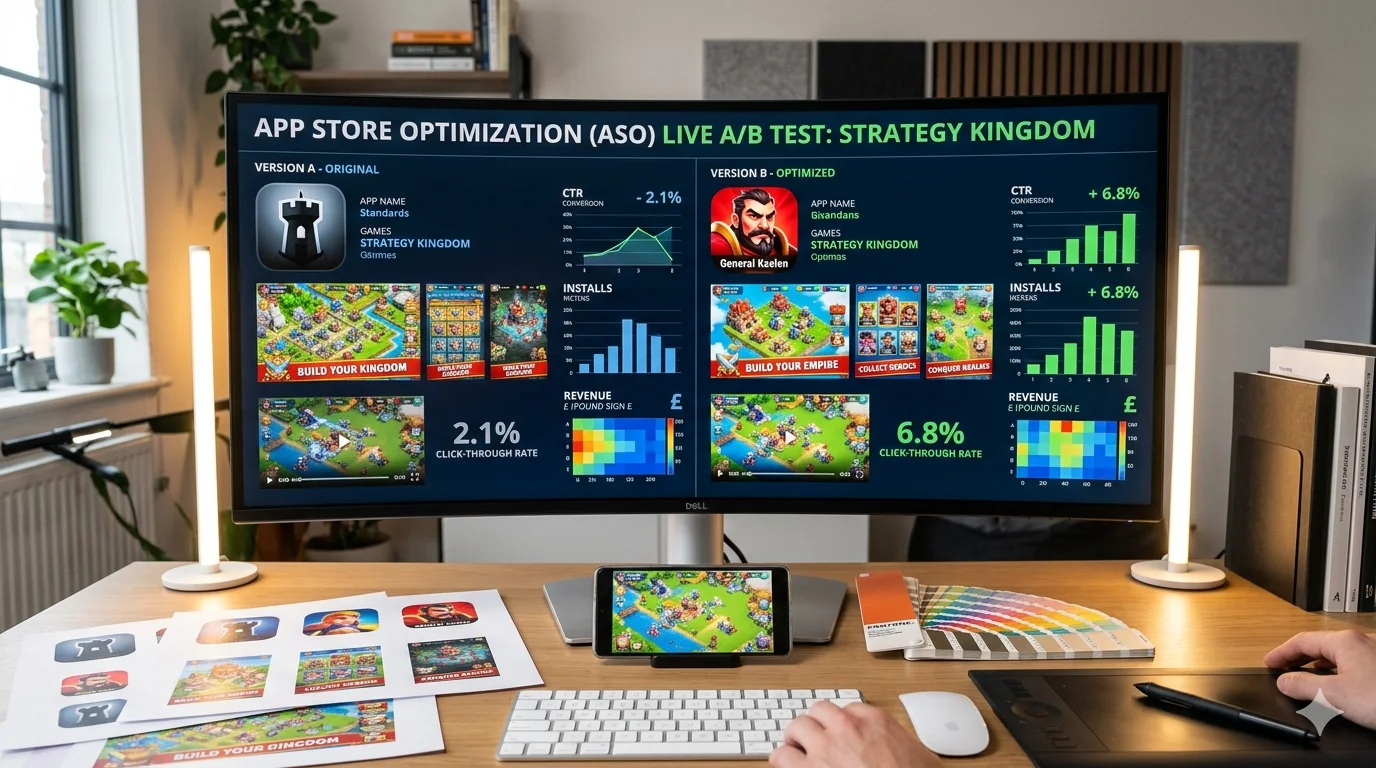
4. A/B Testing Visuals
Testing is essential. Try different versions of your icon, screenshots, and video thumbnails to see which combinations generate more clicks. Small visual adjustments often lead to major improvements in downloads.
Monitoring and Improving ASO Performance
ASO is not a one-time setup. Continuous tracking helps you understand what works and where improvement is needed.
1. Key ASO Metrics to Track
- Impressions: How many users see your app listing.
- Click-through rate (CTR): The percentage of users who tap on your listing after seeing it.
- Conversion rate: The percentage of users who install your app after viewing the store page.
- Keyword rankings: How your app ranks for targeted keywords.
- Ratings and reviews: What users think of your app, and how that affects future downloads.
2. Tools to Measure Performance
Use tools such as AppFollow, AppTweak, or MobileAction to monitor rankings, ratings, and keyword movements. Both Google Play and App Store Connect also provide valuable insights into user engagement and conversion data.
3. Regular Optimisation
If you see high impressions but low clicks, it’s often a visual or messaging issue. Try testing new icons or screenshot sequences. If you see high clicks but low downloads, improve your description and reviews.
4. Encourage Reviews
Positive ratings boost both visibility and trust. Prompt users to rate the game after positive experiences, such as completing a mission or unlocking a new feature. Respond professionally to negative reviews to show that you care about player feedback.
Creating a Long-Term ASO Strategy
A strong ASO strategy for gaming apps involves ongoing effort and data-driven adjustments. Here’s a simple framework to follow:
- Research: Identify your audience, competitors, and target keywords.
- Optimise: Update your title, description, and visuals to align with your findings.
- Measure: Track performance metrics regularly.
- Refine: Use A/B testing to tweak and improve key elements.
- Repeat: ASO is never finished; it evolves as player trends and algorithms change.
The best-performing gaming apps in 2025 are those that treat ASO as a continuous process, not a one-time task.
Final Thoughts
App Store Optimisation is more than just a marketing tactic. It is a long-term growth engine for your game. By understanding how ASO works and applying these strategies consistently, you can improve visibility, attract genuine players, and reduce your dependence on paid ads.
If your app is getting impressions but few clicks, start by examining your icon, screenshots, and title. These are the elements that convince users to take action. Refine your visuals, rework your messaging, and track your metrics closely. With consistent ASO updates, your game can climb the charts and build a steady stream of organic downloads.
If you need help refining your ASO strategy or want expert support to optimise your app store listing, The Game Marketer team is here to help. We specialise in App Store Optimisation for games, helping developers increase visibility, attract the right players, and achieve measurable growth. Contact us today to boost your app’s performance.